

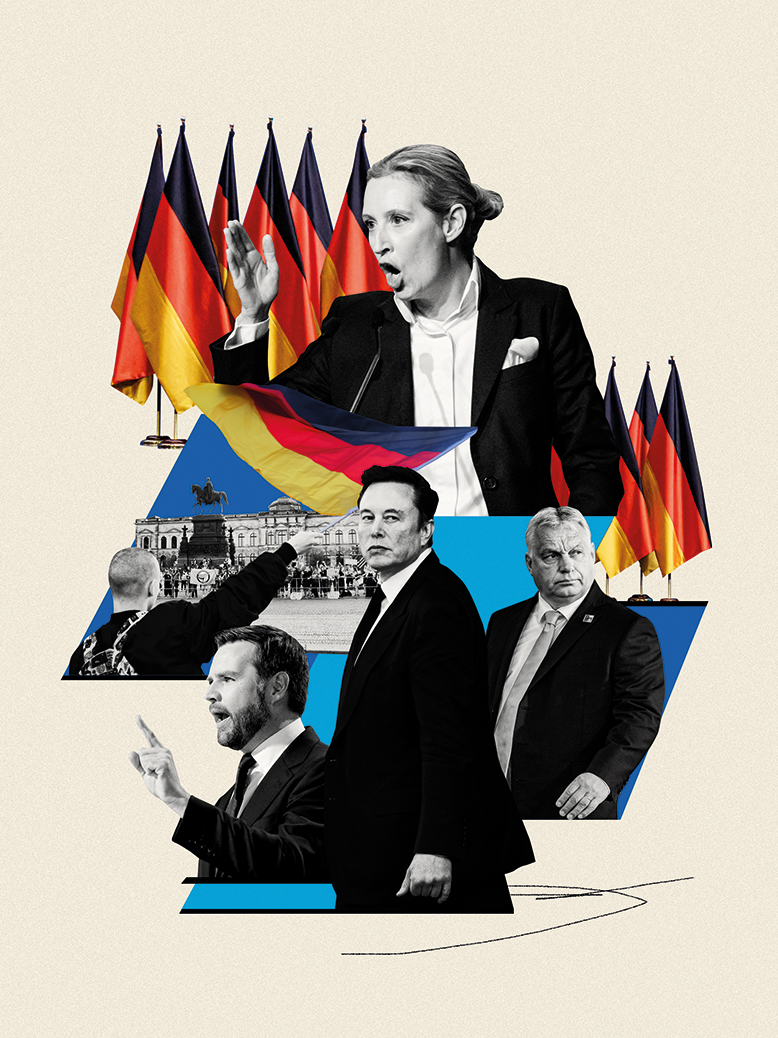
A new
path to power for the far right: Don’t moderate. Stay radical.
The AfD’s
victory in eastern Germany is challenging conventional wisdom about how
populist parties win elections.
By MARION
SOLLETTY
September
11, 2026 4:00 am CET
By Marion
Solletty
https://www.politico.eu/article/a-new-path-to-power-for-the-far-right-dont-moderate-stay-radical/
For
years, Europe’s far right appeared to face a choice: Moderate, or remain on the
margins. The Alternative for Germany party’s landslide victory in Saxony-Anhalt
suggests there may be a third option — radicalize and win.
The
party’s performance in last weekend’s election, where it raked in 44% of the
vote, shattered a widely shared illusion among the European mainstream that the
far right was somehow destined to mellow on its way to power.
That has
broadly been the path taken by Italy’s Giorgia Meloni and France’s Marine Le
Pen. The Italian prime minister’s tilt to the mainstream, especially when it
comes to the EU and NATO, has given a name to the phenomenon: “Melonization.”
Le Pen, for her part, has spent years “de-demonizing” her party, dropping calls
to leave the EU and distancing the party from Russia after Moscow’s invasion of
Ukraine.
The AfD
has moved in the opposite direction, doubling down on anti-immigration,
anti-Islam rhetoric and its pro-Russian stance — and still surging at the
ballot box.
With the
far right polling strongly ahead of major elections expected this year and next
in Sweden, France, Spain, Poland and Italy, the AfD’s breakthrough is
reverberating far beyond eastern Germany. It raises a more troubling
possibility for Europe’s establishment: that the next wave of populist
challengers may see less reason to emulate Meloni or Le Pen — and more
incentive to copy the AfD.
The
election results in Saxony-Anhalt are proof that “nationalist and identitarian
policies” are “exactly the kind of policy we need to win elections and save our
countries,” Afonso Gonçalves, the leader of the ultranationalist Portuguese
movement Reconquista, said.
The
Italian former general Roberto Vannacci, who is challenging Meloni from the
far-right flank she used to occupy, also cheered the win. “Now, keep calling us
extremists,” he posted on X. “If half the population stands with AfD, the
accusations of extremism, by definition, evaporate and vanish.”
From
across the Atlantic, U.S. President Donald Trump weighed in on his social media
platform Truth Social: “Wow! The Populist Party in Germany just had a really
big night. They finally got tired of the absolutely horrible Immigration rules
and regulations, which have hurt Germany so badly. THEY ARE ON THE RISE, and
not going to take it anymore! MGGA!!!”
Meanwhile,
in Italy and France, Le Pen and Meloni have abstained from commenting.
Diverging
paths
The
schism is not a new one. France’s National Rally broke with the AfD in the
lead-up to the 2024 European Parliament election over comments by the German
party’s lead candidates minimizing membership in the Nazi SS paramilitary
organization.
Following
the vote in Saxony-Anhalt, Jean-Philippe Tanguy, a member of Parliament with
the National Rally, told French television he was “shocked” that so many “voted
for people who downplay Germany’s Nazi past.”
By
contrast, the AfD has surged to success in part by empowering some of its most
radical figures. Ulrich Siegmund, the party’s leader in Saxony-Anhalt, first
came to national attention in 2024 for his participation in a closed-door
meeting in Potsdam to discuss plans for the mass deportation of migrants.
The AfD
supports what it calls “remigration” — encouraging people of immigrant
backgrounds to return to their ethnic countries of origin. The party’s platform
in Saxony-Anhalt pitched “financial and non-financial incentives” to push
documented migrants to leave the country.
This
summer, some of the party’s senior members joined a “remigration summit”
headlined by Gregory Bovino, the former commander of the U.S. Border Patrol who
championed mass deportation across the Atlantic. They mingled with other
far-right politicians and activists from parties such as Spain’s Vox and the
U.K.’s Restore Britain, as well as Austrian ethno-nationalist Martin Sellner,
who was banned from entering Germany after his participation in the Potsdam
event.
In
Portugal, Gonçalves is mulling launching a fully fledged political party to
compete with the far-right party Chega. A poll commissioned by Reconquista and
shared with POLITICO showed the movement could net approximately 5 percent of
the vote in general elections.
Reconquista’s
potential bid for political power is part of a wider European trend, in which
activists are challenging far-right parties by outflanking them on issues like
migration. Gonçalves has proposed revoking Portuguese citizenship from
immigrants when it was awarded, in his view, “illegally” and “against the
values of our nation and our identity.”
In
France, rising figures such as Sarah Knafo, a member of the European Parliament
whose party is allied with the AfD, have built momentum with campaign
strategies similar to those deployed in Saxony-Anhalt, combining far-right
stances with strong visual branding.
“There’s
a premium on radical rhetoric,” said Jérôme Jamin, a political science
professor at Liège University in Belgium who has studied populist movements in
Europe and the US. “It pays off, more than it used to.”
Radical
rebranding
Whether
the AfD’s radicalism will be a winning recipe outside their eastern German
strongholds remains an open question. While it fires up the most radical
segment of the electorate, it also scares off many voters. That means it can
yield significant wins at the local level, but fail at the national level,
where candidates need to appeal to a broader segment of the electorate.
Germany’s
mainstream parties have also vowed not to cooperate or form a coalition with
the AfD. That so-called “firewall” is already making it difficult for the party
to form a government in Saxony-Anhalt, where it is three seats short of an
absolute majority. At the national level, where it is polling at 28%, the
possibility looks far out of reach.
In
France, far-right firebrand and polemicist Eric Zemmour tried to outflank
Marine Le Pen, polling ahead of her in the early stages of the 2022
presidential campaign, only to crash in the actual election.
Zemmour’s
challenge ultimately benefited Le Pen, said a former high-ranking member of his
party, who was granted anonymity to speak candidly. “He made her look less
extreme, and in doing so he did her a favor,” the politician said.
Then
there’s the problem of governing. Once actually in power, populist platforms
have a tendency to crash into reality, be it financial or institutional.
That, in
turn, exposes them to the same accusations they have been throwing at centrist
parties for years: that they are unable to improve their citizens’ lives in a
significant way and should make room for those who can.
In
Hungary, Viktor Orbán’s 16-year rule ended in a crushing election defeat
earlier this year after the EU’s most autocratic leader failed to deliver on a
number of promises. In the U.S., a cost-of-living crisis stoked by the Trump
administration’s policies is leaving many Americans behind and has hurt the
government’s approval ratings ahead of midterm elections.
Jamin,
the political scientist, dismissed the idea that the AfD surge or the rise of
online far-right activists is any different in nature from past populist waves
in Europe, inflammatory rhetoric included.
“We got
Trumpism before the Americans did with [late Italian Prime Minister Silvio]
Berlusconi,” Jamin said.
The
difference, he said, was the international political environment. Where
Washington might have once sought to check Europe’s far-right movements, the
Trump administration — with its willingness to blow through legal and
constitutional constraints — is instead inspiring them to go further.
“This
coming from the White House makes people think, ‘We can do the same, this is
the future of politics.’”


.jpeg)

.jpeg)


.jpeg)



Sem comentários:
Enviar um comentário